

 Photo: Alan Findlay
Who Is Actually Listening?
Since 2024, the number of people who listen to podcasts has risen by 6.83%. Pew Research broke down monthly listener age demographics in 2025, with 67% of 18-29 year olds listening to podcasts, followed by 62% aged 30-49, 50% aged 50-64, and 33% over the age of 65. Comedy remains the most beloved podcast type, making up 30% of listening hours, this was followed by societal and cultural at 18%, and lifestyle at 15%, with educational podcasts at a low 7%.
Statista examined podcast listeners in the DACH region finding that many listeners have a high income. 37% of podcast listeners are looking for entertainment while 15% are innovators and product developers. German listeners also report that social issues are important to them, with many wanting climate change as an issue that should be addressed – pointing out DACH’s dedication to sustainability.
As for marketing, Statista reports that podcast listeners are better at remembering ads than the average consumer. Moreover, Edison Research writes that 67% of listeners are not bothered by sponsorship messages or ads, with some listeners finding them useful. This also translates into trust, with listeners more likely to trust the ads they hear on podcasts than on other platforms. This results in 54% of listeners being more likely to buy from brands they learn about on podcasts.
Top Podcast Trends Marketers Need to Know
With the increasing number of podcasts being released, the format, production, and content is slowly changing to match consumer needs. As consumers tend to trust podcasts when it comes to products, brands are beginning to see these platforms as powerful marketing tools, ultimately teaming up with hosts to bring their products to consumers in a subtle way. These trends point to a desire within listeners to have more personalized, immersive experiences that provide engaging entertainment.
-
- Video
Podcasts are no longer just an auditory experience, as 64% of listeners like having video as well. Spotify reports that 40% of users who listened to a podcast chose a video podcast, with listener retention being 26% higher than podcasts without video. Video is changing the format of podcasts, but it is an essential aspect to this media especially when it comes to marketing as brands can better communicate their identity, products, and services, through visuals.
-
- Personalization
Sitting and talking is not enough to compete in the podcast industry, podcasters must find unique and entertaining ways to grab their listeners’ attention. Right now, 71% of listeners want a personalized experience, and in a world with many podcasts, unique detail is what will create loyal listeners.
From Q&As where podcasters hear directly from their audience, to polls on the types of content listeners want to see, creators need to make sure they are speaking directly to their audience by tailoring their content to them. Not only that, but listeners are looking for connection with the host, this makes it essential for creators to focus on developing this connection through more personalization and relatability.
-
- Live Interaction
Gone are the days of overproduced podcasts. Users want real, authentic stories, they want the truth. How is this done? Through live recording sessions where podcasters can interact directly with their audience in real time. This type of podcast also encourages more engagement, while delivering a personalized element by facilitating live conversation with their loyal following.
-
- Content, Content, Content
Podcasts must focus on creating genuine, interesting, and unique content. This is especially true when it comes to content repurposing, where the point is to generate as much content as possible from one episode. This is leading to one podcast episode generating a multitude of different content types like social media posts, short form videos, articles, blogs etc.
From this the short form content trend has emerged, where episodes are being created and edited in a way that is extremely shareable, with attention grabbing elements that will turn heads on social media.
-
- AI as a game changer
AI tools are being used to edit and publish podcasts efficiently and effectively. Tools are being released that are directed at helping make podcasts more accessible to both hosts and consumers. For example, Descript allows users to edit their podcasts using AI, creating a place where hosts can record, transcribe, make clips, and publish. This all in one type of AI tool has become increasingly more common with other platforms like Riverside or VEED. From editing tools, to tools that highlight the most shareable clips, to caption generation, AI is making podcasting an easier, simpler experience.
 Photo: Flipsnack on Unsplash
Why Podcasts Work as a Marketing Tool (and When to Use Them)
So, what makes podcasts such an incredible marketing tool? It all comes down to audience engagement. As we highlighted before, the personalization, authenticity, and genuine connection between podcaster and audience is what essentially leads to an increase in trust. Moreover, consumers are more likely to trust podcasters because the consumer themself is in control of who they subscribe to. Due to this trust, audiences are more likely to buy products suggested by the host.
Where podcasts really shine, is within their contributions to the customer journey for decision-making rather than the awareness phase. Generally, podcasts are most relevant for the purchase phase when consumers are trying to decide whether or not to buy a product. At this stage, the consumer is already showing an interest around the topic or product with the podcast serving as a deciding factor. This means that a customer wants information as well as expertise, reliable opinions, and validation that their purchase is the right one. They are trying to understand all the elements of the product while gauging the reviews.
The average consumer will utilize search platforms, brand websites, and e-commerce sites to research the best products on the market. If they have access to a podcast that they trust, however, they can easily learn tips, tricks, and insights to make an informed decision, thus needing less time to research, leaving more time to engage with your brand. Podcasts are a way for marketers to shorten the research phase, satisfying consumers with all the information they need in one place. This allows consumers to make decisions quicker, while slowly solidifying brand loyalty.
The Secret to a Podcast that Converts: Intimate & Reliable Content
Both a trend and an important insight into using podcasts effectively, highlighting what we call “the journey” is what will make your podcast stand out. With consumers wanting more personalization, more connection, and more entertainment, painting your podcast as unique is essential in a world where big corporations such as Netflix, Spotify, Amazon and Apple are overshadowing smaller independent podcasts. These new manicured, marketed, and overproduced podcasts are pushing loyal listeners away because the content is no longer unique nor is it organic. Podcasts are only powerful marketing tools when they focus on your emotional reliability to build story driven content that frames the customer journey in a way that allows listeners to connect with your brand.
The customer journey represents the way a consumer interacts with a brand – from awareness, to consideration, to purchase, to retention, and finally to loyalty. Podcasts are essential in the consideration phase, but only when they develop emotional connection through engaging story driven content. This is why authenticity is so important, as the customer genuinely relies on the opinions and suggestions of the hosts.
By using story driven content, marketers can develop narratives that resonate with their audience, rather than pushing bland, lifeless advertisements. Communicating your brand’s story builds connection while helping consumers put a face to the company. Highlighting quality, authenticity, and genuine experiences can make your audience feel involved in your brand, thus feeling more inclined to make the purchase. Storytelling is key to building a brand identity. This identity is a way to create a sense of community surrounding your company, ultimately strengthening ties between your target consumers and your brand.
Examples of how to use story driven content in your podcasts:
-
- Founder-led podcasts
- Exploring brand values – why you act
- Highlighting unique aspects of your brand
- The brand’s origin story
- Demonstrating your problem solving through before and after
- Behind the scenes – spotlight employees
- Customer spotlight – bring on real customers to talk about your brand
How We Do It: The S-Word
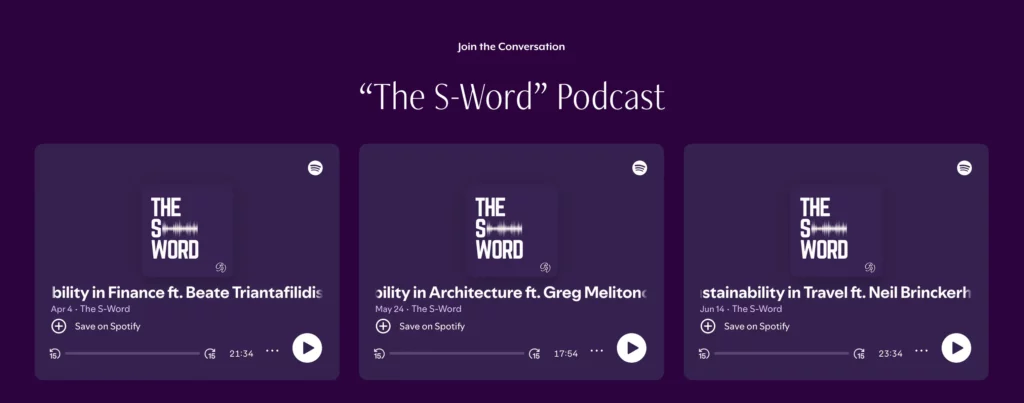
Our podcast, The S-Word, is dedicated to spreading our brand’s values by discussing the things we care about most – sustainability and the travel and tourism industry. We use our platform to dive deeper into how sustainability permeates through every industry, detailing realistic solutions from eco-friendly experts. We want our audience to understand where our company culture stems from while clearly communicating what we care about. Not only does our podcast help position us as experts on sustainability as we curate content that is both interesting and insightful, but it also allows us to build our brand identity alongside our audience’s trust.
Season one of The S-Word takes listeners through different industries, as our managing director, Natascha, interviews experts from each sector. From exploring sustainability in education by listening to a teacher’s perspective on it, to examining sustainability in architecture featuring New York City based designer Greg Melitonov.
In episode three, we look at how sustainability is relevant for travel, with our expert, Neil Brinckerhoff, giving listeners important insights and tips on how to choose the right accommodation or transportation, highlighting that the way tourists spend money can make all the difference. We found this topic to be extremely important, as it provided our audience with a better understanding of how travel can be sustainable, and the steps it takes to get there.
Each episode allows an expert to help listeners understand the way sustainability is and must be woven throughout all areas of life. Season one highlights Rupp’s core message – that through the power of communication, we can do good. We chose experts that could provide interesting and unique insight that would inspire listeners to do good and to bring a little sustainability into their own lives, maybe even thinking of topics they never thought about before.
Season two of The S-Word focused specifically on sustainability in hospitality – our expertise. Together with our partner, MAp Consultancy, we discussed all aspects of sustainable communications for hotels. With topics on what makes a hotel sustainable, what and how to communicate, and a Q&A that answered questions from our audience to promote engagement. This season honed in on our skills and knowledge around sustainable communications, helping to position us as experts and offer real guidance to our listeners.
Starting our own podcast has made us aware of how difficult the first few steps can be. Finding the right guests, recording and letting the content flow authentically, editing and producing, to finally publishing, can be a daunting task. Moreover, understanding how and when to use the podcast as a marketing strategy can be even more confusing. If you are interested in starting your own podcast but not sure where to start, don’t hesitate to get in touch with us.
Podcasts are a Powerful Tool
When podcasters focus on crafting authentic, genuine stories that are geared towards helping their audience make the right purchasing decisions, then they can be used as powerful marketing tools. Understanding your audience and what they need from you, including reliable information, genuine opinions, and emotional connection, will only increase brand awareness and help turn potential consumers into loyal customers. It’s so important to create audio content that inspires your audience to want to buy the product and that makes them feel like they are part of your community.
Looking to get into podcasting? Reach out to us at Rupp to get started.
[/vc_column_text][/vc_column][/vc_row]
The addition of a podcast category at the 2026 Golden Globes split the internet – with the awards show receiving negative backlash, especially because the hosts were Hollywood celebrities. This begs the question whether podcasts are still relevant? With worsening attention spans, an exhausting number of new podcasts hitting the market, and consumers becoming increasingly more unsatisfied, it feels like the over-proliferation of this form of media is driving people away.
Despite this, it seems as though podcasts are continuing to grow with new innovations like their format shifting to include visuals and platforms such as Netflix adding a Podcast category. From YouTube to Spotify to Netflix, the world of podcasts is growing with these large media companies investing more into hosts, production, and marketing.
In fact, this form of content can make a really important marketing tool, as our podcast expert, Sainey argues. “It’s not just about marketing,” she explains, “But content marketing, understanding who you are marketing your podcast to. Actual buyers remain Gen x and Millennials who do have longer attention spans. Therefore making it crucial that podcasts speak to these audiences with less of a focus on the younger generations.”
To understand the effectiveness of podcasts as a marketing tool, we’ll take a look at the Modern Podcast and the insights and trends which are shaping the industry. From the addition of video, to the need for more story driven content, these trends will help build a powerful, unique podcast. Looking at them from a marketing perspective, we’ll put them into action to explore how podcasts can be used to show off your products, using our own podcast, The S-Word, as a case study.
Photo: Alan FindlayWho Is Actually Listening?
Since 2024, the number of people who listen to podcasts has risen by 6.83%. Pew Research broke down monthly listener age demographics in 2025, with 67% of 18-29 year olds listening to podcasts, followed by 62% aged 30-49, 50% aged 50-64, and 33% over the age of 65. Comedy remains the most beloved podcast type, making up 30% of listening hours, this was followed by societal and cultural at 18%, and lifestyle at 15%, with educational podcasts at a low 7%.
Statista examined podcast listeners in the DACH region finding that many listeners have a high income. 37% of podcast listeners are looking for entertainment while 15% are innovators and product developers. German listeners also report that social issues are important to them, with many wanting climate change as an issue that should be addressed – pointing out DACH’s dedication to sustainability.
As for marketing, Statista reports that podcast listeners are better at remembering ads than the average consumer. Moreover, Edison Research writes that 67% of listeners are not bothered by sponsorship messages or ads, with some listeners finding them useful. This also translates into trust, with listeners more likely to trust the ads they hear on podcasts than on other platforms. This results in 54% of listeners being more likely to buy from brands they learn about on podcasts.
Top Podcast Trends Marketers Need to Know
With the increasing number of podcasts being released, the format, production, and content is slowly changing to match consumer needs. As consumers tend to trust podcasts when it comes to products, brands are beginning to see these platforms as powerful marketing tools, ultimately teaming up with hosts to bring their products to consumers in a subtle way. These trends point to a desire within listeners to have more personalized, immersive experiences that provide engaging entertainment.
-
- Video
Podcasts are no longer just an auditory experience, as 64% of listeners like having video as well. Spotify reports that 40% of users who listened to a podcast chose a video podcast, with listener retention being 26% higher than podcasts without video. Video is changing the format of podcasts, but it is an essential aspect to this media especially when it comes to marketing as brands can better communicate their identity, products, and services, through visuals.
-
- Personalization
Sitting and talking is not enough to compete in the podcast industry, podcasters must find unique and entertaining ways to grab their listeners’ attention. Right now, 71% of listeners want a personalized experience, and in a world with many podcasts, unique detail is what will create loyal listeners.
From Q&As where podcasters hear directly from their audience, to polls on the types of content listeners want to see, creators need to make sure they are speaking directly to their audience by tailoring their content to them. Not only that, but listeners are looking for connection with the host, this makes it essential for creators to focus on developing this connection through more personalization and relatability.
-
- Live Interaction
Gone are the days of overproduced podcasts. Users want real, authentic stories, they want the truth. How is this done? Through live recording sessions where podcasters can interact directly with their audience in real time. This type of podcast also encourages more engagement, while delivering a personalized element by facilitating live conversation with their loyal following.
-
- Content, Content, Content
Podcasts must focus on creating genuine, interesting, and unique content. This is especially true when it comes to content repurposing, where the point is to generate as much content as possible from one episode. This is leading to one podcast episode generating a multitude of different content types like social media posts, short form videos, articles, blogs etc.
From this the short form content trend has emerged, where episodes are being created and edited in a way that is extremely shareable, with attention grabbing elements that will turn heads on social media.
-
- AI as a game changer
AI tools are being used to edit and publish podcasts efficiently and effectively. Tools are being released that are directed at helping make podcasts more accessible to both hosts and consumers. For example, Descript allows users to edit their podcasts using AI, creating a place where hosts can record, transcribe, make clips, and publish. This all in one type of AI tool has become increasingly more common with other platforms like Riverside or VEED. From editing tools, to tools that highlight the most shareable clips, to caption generation, AI is making podcasting an easier, simpler experience.
Photo: Flipsnack on UnsplashWhy Podcasts Work as a Marketing Tool (and When to Use Them)
So, what makes podcasts such an incredible marketing tool? It all comes down to audience engagement. As we highlighted before, the personalization, authenticity, and genuine connection between podcaster and audience is what essentially leads to an increase in trust. Moreover, consumers are more likely to trust podcasters because the consumer themself is in control of who they subscribe to. Due to this trust, audiences are more likely to buy products suggested by the host.
Where podcasts really shine, is within their contributions to the customer journey for decision-making rather than the awareness phase. Generally, podcasts are most relevant for the purchase phase when consumers are trying to decide whether or not to buy a product. At this stage, the consumer is already showing an interest around the topic or product with the podcast serving as a deciding factor. This means that a customer wants information as well as expertise, reliable opinions, and validation that their purchase is the right one. They are trying to understand all the elements of the product while gauging the reviews.
The average consumer will utilize search platforms, brand websites, and e-commerce sites to research the best products on the market. If they have access to a podcast that they trust, however, they can easily learn tips, tricks, and insights to make an informed decision, thus needing less time to research, leaving more time to engage with your brand. Podcasts are a way for marketers to shorten the research phase, satisfying consumers with all the information they need in one place. This allows consumers to make decisions quicker, while slowly solidifying brand loyalty.
The Secret to a Podcast that Converts: Intimate & Reliable Content
Both a trend and an important insight into using podcasts effectively, highlighting what we call “the journey” is what will make your podcast stand out. With consumers wanting more personalization, more connection, and more entertainment, painting your podcast as unique is essential in a world where big corporations such as Netflix, Spotify, Amazon and Apple are overshadowing smaller independent podcasts. These new manicured, marketed, and overproduced podcasts are pushing loyal listeners away because the content is no longer unique nor is it organic. Podcasts are only powerful marketing tools when they focus on your emotional reliability to build story driven content that frames the customer journey in a way that allows listeners to connect with your brand.
The customer journey represents the way a consumer interacts with a brand – from awareness, to consideration, to purchase, to retention, and finally to loyalty. Podcasts are essential in the consideration phase, but only when they develop emotional connection through engaging story driven content. This is why authenticity is so important, as the customer genuinely relies on the opinions and suggestions of the hosts.
By using story driven content, marketers can develop narratives that resonate with their audience, rather than pushing bland, lifeless advertisements. Communicating your brand’s story builds connection while helping consumers put a face to the company. Highlighting quality, authenticity, and genuine experiences can make your audience feel involved in your brand, thus feeling more inclined to make the purchase. Storytelling is key to building a brand identity. This identity is a way to create a sense of community surrounding your company, ultimately strengthening ties between your target consumers and your brand.
Examples of how to use story driven content in your podcasts:
-
- Founder-led podcasts
- Exploring brand values – why you act
- Highlighting unique aspects of your brand
- The brand’s origin story
- Demonstrating your problem solving through before and after
- Behind the scenes – spotlight employees
- Customer spotlight – bring on real customers to talk about your brand
How We Do It: The S-Word
Our podcast, The S-Word, is dedicated to spreading our brand’s values by discussing the things we care about most – sustainability and the travel and tourism industry. We use our platform to dive deeper into how sustainability permeates through every industry, detailing realistic solutions from eco-friendly experts. We want our audience to understand where our company culture stems from while clearly communicating what we care about. Not only does our podcast help position us as experts on sustainability as we curate content that is both interesting and insightful, but it also allows us to build our brand identity alongside our audience’s trust.
Season one of The S-Word takes listeners through different industries, as our managing director, Natascha, interviews experts from each sector. From exploring sustainability in education by listening to a teacher’s perspective on it, to examining sustainability in architecture featuring New York City based designer Greg Melitonov.
In episode three, we look at how sustainability is relevant for travel, with our expert, Neil Brinckerhoff, giving listeners important insights and tips on how to choose the right accommodation or transportation, highlighting that the way tourists spend money can make all the difference. We found this topic to be extremely important, as it provided our audience with a better understanding of how travel can be sustainable, and the steps it takes to get there.
Each episode allows an expert to help listeners understand the way sustainability is and must be woven throughout all areas of life. Season one highlights Rupp’s core message – that through the power of communication, we can do good. We chose experts that could provide interesting and unique insight that would inspire listeners to do good and to bring a little sustainability into their own lives, maybe even thinking of topics they never thought about before.
Season two of The S-Word focused specifically on sustainability in hospitality – our expertise. Together with our partner, MAp Consultancy, we discussed all aspects of sustainable communications for hotels. With topics on what makes a hotel sustainable, what and how to communicate, and a Q&A that answered questions from our audience to promote engagement. This season honed in on our skills and knowledge around sustainable communications, helping to position us as experts and offer real guidance to our listeners.
Starting our own podcast has made us aware of how difficult the first few steps can be. Finding the right guests, recording and letting the content flow authentically, editing and producing, to finally publishing, can be a daunting task. Moreover, understanding how and when to use the podcast as a marketing strategy can be even more confusing. If you are interested in starting your own podcast but not sure where to start, don’t hesitate to get in touch with us.
Podcasts are a Powerful Tool
When podcasters focus on crafting authentic, genuine stories that are geared towards helping their audience make the right purchasing decisions, then they can be used as powerful marketing tools. Understanding your audience and what they need from you, including reliable information, genuine opinions, and emotional connection, will only increase brand awareness and help turn potential consumers into loyal customers. It’s so important to create audio content that inspires your audience to want to buy the product and that makes them feel like they are part of your community.
Looking to get into podcasting? Reach out to us at Rupp to get started.